What It Really Takes to Reach B2

After teaching German for thousands of hours and working with learners from dozens of different countries, I’ve noticed this:
Many people dramatically underestimate what it actually takes to reach B2.
They also underestimate how achievable it becomes once they approach it correctly.
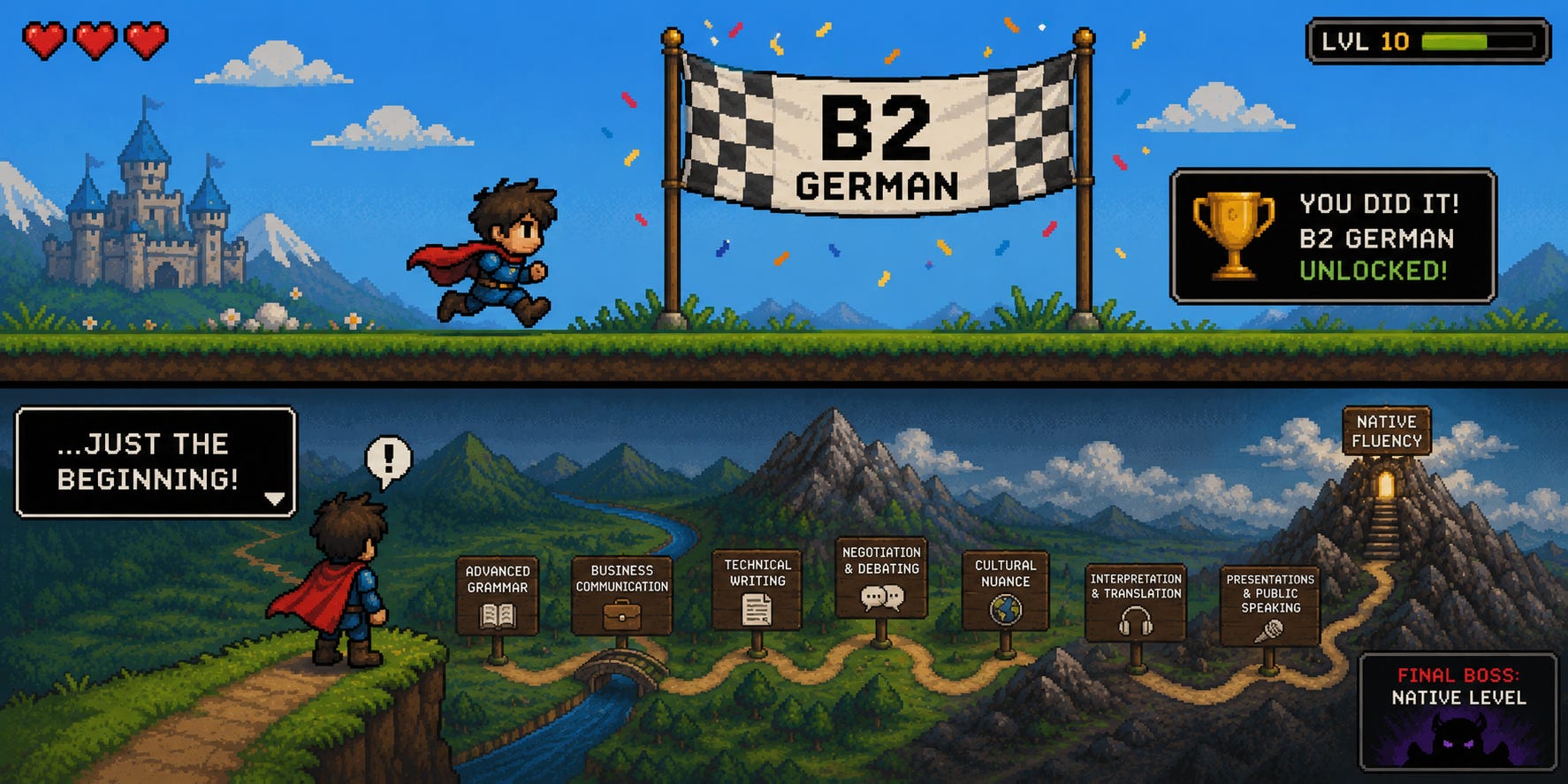
Many language learners imagine B2 or C1 as the point where they suddenly become “fluent.”
However, in reality, reaching B2 is not some sort of a magical finish line.
It is more the stage where the new language slowly stops feeling like constant problem-solving.
You translate less.
You start reacting faster.
You recognize patterns more automatically.
You stop building every sentence from scratch.
Once you reach B2, a lot of doors in German-speaking countries start opening.
In Germany, Austria, and Switzerland, B2 is often enough to:
work in many professional environments
study at certain universities or preparation programs
handle most everyday bureaucracy independently
build friendships and relationships more naturally
participate more fully in society instead of constantly feeling “outside” of it
For many people, B2 is the level where life in the language truly begins.
But getting there requires something many learners underestimate:
Volume.
You need enough exposure and repetition for your brain to build automaticity.
Because reaching B2 is not mainly about collecting more information anymore.
It’s more about making the information you already know accessible under real-time pressure.
That’s why so many learners technically “know” German at B1 level, but still struggle to speak naturally.
Their knowledge exists…
…but it’s not yet fast enough.
Not yet stable enough.
Not yet automatic enough.
German makes this process demanding because the language places a high cognitive load on working memory.
While speaking, your brain constantly has to manage:
word order
verb placement
grammatical gender
cases
adjective endings
sentence-final verbs
and long informational chunks
Especially in spontaneous conversations.
That’s why German learners often feel mentally exhausted after social interactions, even when they understand most of the conversation.
Your brain is doing a huge amount of invisible processing in the background.
But here’s the encouraging part:
You do not need perfect German to reach B2.
You need functional automaticity.
You need enough repetitions that common structures become instinctive instead of calculated.
And realistically, for most learners, B2 in German roughly looks like this:
~5,000 words.
~150 main grammar patterns.
~10 hours per week of consistent practice for around 100 weeks.
With roughly:
– 50% input (listening & reading)
– 25% output (speaking & writing)
– 25% grammar & vocabulary study
Of course this varies depending on your native language, environment, intensity, and learning quality.
But overall, fluency is much less mysterious than people think.
Research in second-language acquisition consistently shows that repeated exposure, retrieval, and meaningful output are some of the strongest drivers of long-term language development.
In simple terms:
Your brain learns languages through repeated successful contact with patterns.
Again.
And again.
And again.
This is why learners who improve the fastest usually do not obsess over isolated grammar rules all day.
Instead, they spend large amounts of time interacting with understandable, repetitive, real-world language.
Listening.
Reading.
Writing.
Speaking.
Consistently.
Not perfectly.
That’s the real road to B2.
Sustained exposure long enough for your brain to adapt.
That is also exactly why I built my training system the way I did.
Every week, you receive structured training units focused on real conversational German, repeated exposure, speaking prompts, listening practice, and active output.
If you haven’t already, consider upgrading your subscription for the price of half a Döner per month:
Fluency is not built through motivation alone.
It’s built through repeated interaction with the language over time.
And if you stay consistent long enough, your brain eventually starts doing what once felt impossible automatically.
LG und schöne Woche 💪
Marwan